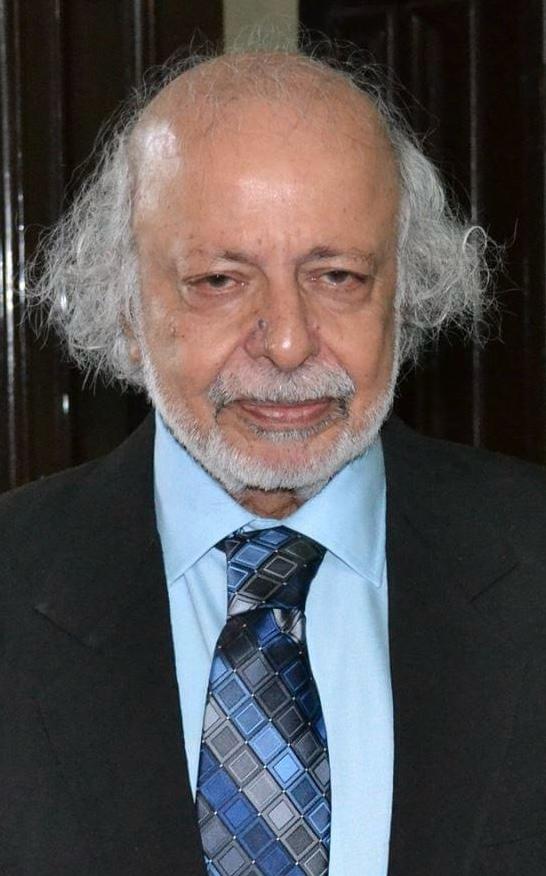
Prof. P. C. Kapur
Prof Prakash Chand Kapur, a legendary figure in the field of mineral processing, extractive metallurgy and materials product development, was a distinguished professor at IIT Kanpur. Prof Kapur obtained MSc (1953) in Chemistry from Bombay University; MS (1964) and PhD (1968) in Material Science and Mineral Engineering from University of California, Berkeley, USA. After graduation, Prof Kapur worked as a consultant to a think-tank Melpar Inc. on novel, energy efficient and environmentally acceptable strategies for mining coal. Prof Kapur joined the Department of Metallurgical Engineering at IIT Kanpur in 1969 where he developed population balance based mathematical models of particulate processes for comminution, agglomeration, flotation, sintering, etc. He has spent 2 years (1991-93) as Phoebe Apperson Hearst Distinguished Scholar at University of California, Berkeley.
Prof Kapur worked closely with the industry. He spent a year (1956-57) at ElectroKohle Litchtenberg (formerly Siemens Plania A.G.) East Berlin for the manufacture of technical and electrical carbon and graphite products; four years (1958-62) as Research Engineer at Burn & Co. Refractory and Ceramic Division for development of Carbon, Basic Chrome Magnesite, Chemically Bonded Iron Clad refractories for steel plants; and a year (1968-69) at the Colorado School of Mines Research Foundation on flotation of phosphates with seawater, flotation of coarse particles, dewatering of industrial wastes and simulation of Bond grindability test.
Prof Kapur had a highly productive collaboration with Tata Research Development and Design Centre (TRDDC) in Pune as a Consulting Advisor. His contributions to data reconciliation, modelling and simulation of unit operations (crushing, grinding, flotation, filtration, etc.) resulted in the development of TCS software tools called Predict and SimL8 for design, synthesis and optimization of complex mineral processing circuits.
Prof Kapur invented a highly affordable water filter based on rice husk ash for removal of E. coli and similar pathogens. The filter, which does not require electricity, was developed further by TRDDC. It was later commercialized as Tata SwachTM by Tata Chemicals.
Prof Kapur along with the TRDDC team worked on the production of eco-cements produced from industrial and mining wastes, at a low clinkering temperature (compared to conventional Portland cements) and requiring much less energy in clinker grinding (eco-cement clinkers are soft) but engineered to match all physical properties of the Portland cements. A wide variety of wastes including coal fly ash, tailings produced during gold mining and processing, fertilizer chalk waste, spent pot lining and red mud, municipal waste incinerator ash and several other metallurgical waste products were converted into eco-cements,
Prof Kapur published nearly 150 papers in international journals of repute. He is Fellow of Indian National Academies of Engineering (INAE), Sciences (IASc) and Ceramics (IICERAM). He is an International Member of the National Academy of Engineering, USA.
Prof Kapur is a recipient of Frank F Aplan Award of the Engineering Foundation (USA); GC Kuczynski prize of the International Institute for the Science of Sintering (Europe) and NRDC National Invention Award (India), to cite a few. In 2012 Prof Kapur was honoured with the prestigious IMPC Lifetime Achievement award by the International Mineral Processing Council in recognition of his outstanding contributions to mineral engineering.
A Special Issue of Transactions of the Indian Institute of Metals on Selected Topics in Mineral Processing and Extractive Metallurgy in Honour of Professor P. C. Kapur was published recently.
© Department of Materials Science and Engineering, IIT Delhi